Pages

Showing posts with label hawaii. Show all posts

Saturday, March 15, 2014

New Work
from
 Matsu Kaze Woodworking

Aloha One and All thanks for checking in at the Matsukaze Blogspot.

 I recently completed an Isho Yaro Dansu.
18.25 x 38 x 42

curly koa, silk oak, port orford cedar, australian cedar, 
western red cedar, bronze, iron

The Isho Yaro were a single piece tansu. There were many differing drawer configurations
some implementing safe doors and drop fit doors.
I enjoy this particular style with the two small drawers for keepsakes or small clothing accessories.
The small drawers also allow for secret compartments and boxes known as hesokuribako.
Which loosely means belly button chestnut box .....
An elderly Japanese lady  had said  to me  that wives would stash kuri ( or coins) in their heso away from their husbands. Who knows, maybe when the husband was looking for some cash to go to the pub or some other
nonessential expenditure.
Either way, I enjoyed the story and pass it on to you.
 So without further ado here's some images in a variety of day time light.......


 The carcass top and sides are  made from rare single 18.25" wide boards in the typical Matsu Kaze fashion.
Beautiful Hawaiian Gold Koa from salvaged dead trees in upper Kaiwiki  just a stones throw from our house on the foot hills of Mauna Kea. Elevation approx.2500'

 The carcass is fully joined with through double tenons and dovetails , hand cut of course. The corners are mitered to facilitate the oval faced edge of the front  to flow around the exterior and the dividing partitions terminate in sword tip miters.

The drawer front material is quite elegant. The board that I was able to eek out two tansu from came from under a house in Mountain View area. A widow of an off bearer was selling off boards that her late husband had collected and stashed over forty years ago and had been air drying since.
I would love to know who has the rest of the tree or see what they made from it.

 It's absolutely stunning Koa. A true 5A Curl with sweet cat's paw burls scattered about.
The color changes in the light from a vibrant gold amber to a rich  Kona coffee. Very dynamic.

The drawer side and back material is Silk Oak from Australia, planted here in the early 1900's
It's easy to work and very beautiful itself.  I had saved some of my best pieces for this project.
This drawer in particular has some nice wide ray flecks. It contrasts nicely with the darker Koa highlighting the joinery.


Drawer bottoms are made from  Port Orford Cedar and left with only a hand planed finish
so not to restrict the aromatic quality of the wood.


The drawer bottoms are .45" solid Port Orford Cedar made in a traditional  Western style with beveled edges beneath  and secured with a brass screw.


The kanagu , metal fittings, on the chest are of the Mokko Style. It's shape is reminiscent of a half cross section of a melon I do not know the name of. I like the mating of these Mokko with a Matsu or Pine bow motif back plate. The handles are caste in bronze and the back plates are steel. The straps that hold the handles to the drawer are forged steel and all is presented in a blackened oil patina.The back plates are worked with a hammer, edges are hand filed to a  neat bevel, and the four nails are of a wrought appearance.
The handles were caste by Daniel Chisler, now retired.  He was the only place in the world to source these handles. I still have a small inventory and a couple sizes to round out a suite that he and I developed together. Exceptional work by an exceptional craftsman. Thank-you Dan.


When you remove the small top drawer you will find a hidden box behind.......


The box is made from koa left over from the Koa Sugi Chadansu from last year.

Lined with Toon an Australian Cedar, which to me is exactly like Spanish mahogany..... 
Toon polishes to a exceptional sheen with hand planes.

There is one more hidden box but out of respect for the future owner I can not disclose the location.
It's made from Toon with a curly koa top.


The back of the Tansu is made of Western red cedar. Some tight grained quarter sawn boards. 
I make the backs in a frame and panel style with through tenons for extra rigidity.
 The cedar helps keep down the overall weight of the tansu and adds to the bouquet of cedars used in the piece.


The finish is Super Blonde Shellac, made from flake here at my shop to ensure freshness
and clarity. It is applied in a french polish method.  To me there is no finer finish than shellac over a hand planed surface save for urushi. Super Blonde is lighter in tone to Blonde which I use from time to time for it's vintage appearance.


So now we have a Japanese tansu of Hawaiian woods with a French polish built by one haole from Maine..... 
 If you can find a more cross cultural piece please share!

Thank-you for taking a moment to view the new Tansu.


 This Piece is Exclusively Available  from
The Harbor Gallery 
Located in Kawaihae , Hawaii
808-882-1510
say hello to Gunner and Elli for me.
 The Harbor Gallery represents over 100 of
The Island of Hawaii's
Best Artists and Artisans

On the way out I will  share some images I snapped during the construction of the piece.
 The process inherently affects the finished work.  
Matsu Kaze Tansu are uniquely handcrafted.


Po napping on the job.....


this is a hand planed surface prior to the french polish......


Another member of the zoo......


Everyone has to be in the show......


 M a t s u  K a z e  W o o d w o r k i n g
simple   devices   for   inspired   living

H    I    L    O             H    A    W    A    I    I 

 info@matsukazewoodworking.com


Saturday, February 22, 2014

 Happy Belated New Year
from 
Matsu Kaze Woodworking
松 風 木 工
 Sorry for the delayed well wishing, I have been absolutely busy.
 There are many things that never get blogged about due to lack of hours in the day so
 I wanted to give you a quick recap of  some work that was not shared with you all in 2013.
 I may go back further in an upcoming post on some constructional details, such as the splay legged table .
If you would like to see anything in particular please write me and I will send you images directly.

 It's been an exceptionally busy past year and I can not thank my patrons and the good people of
 the Harbor Gallery in Kawaihea, Hawaii for all their continued support.
 I truly wish success and happiness to you all  (and you good readers as well)!
 Here goes.....

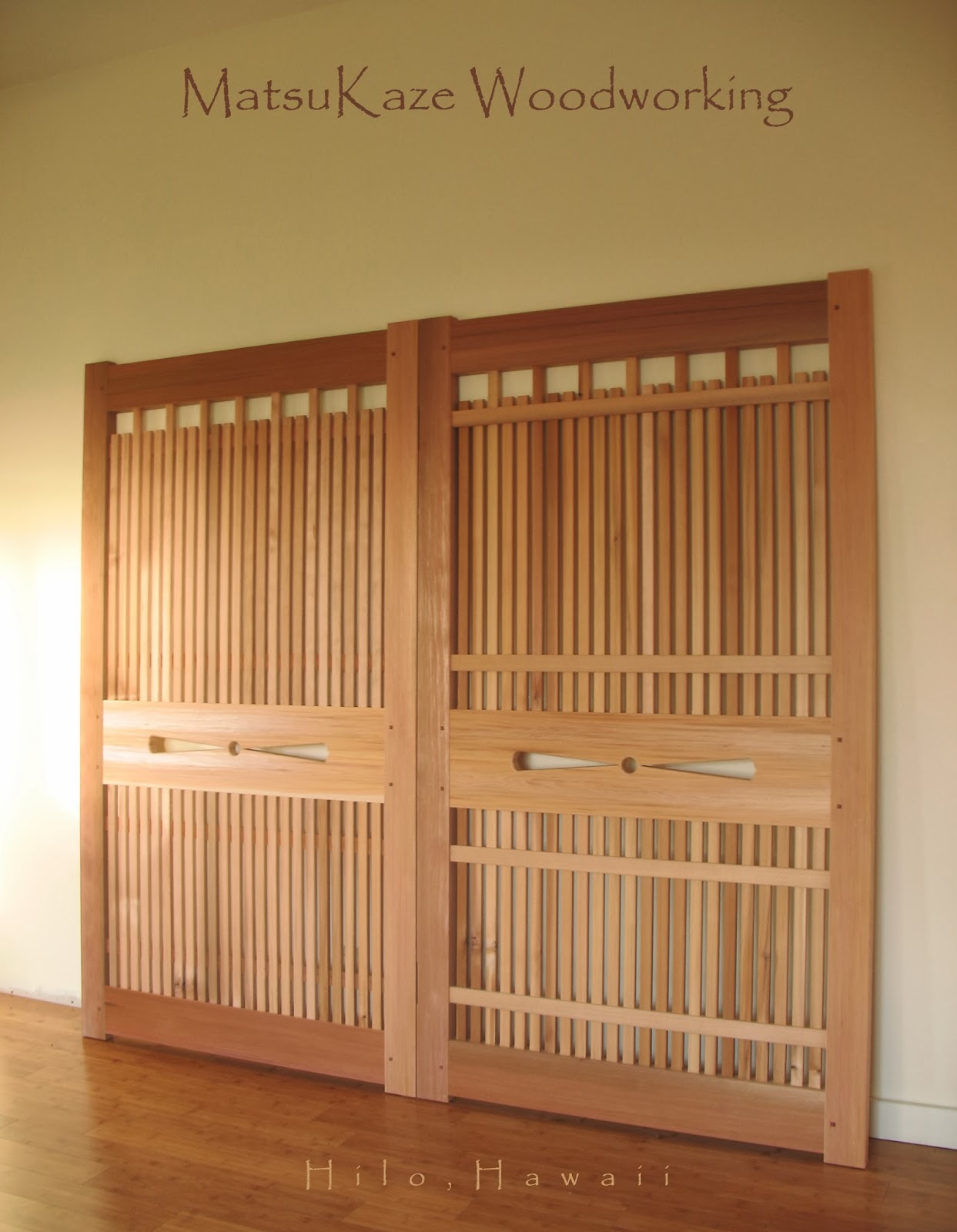
Koshido 
Japanese gate way / entry doors
Appropiate in a garden gate setting or genkan


Pictured front and back. Unfinished hand planed surfaces.
Western Red Cedar

too many mortices to count
the lap joints were all cogged.

Installed in existing opening


Monkey Pod Table with splayed legs.

This was a massive piece. Fully joined with double and quadruple tenons pegged and wedged.

4" thick averaging 42" wide and 10 feet long. 
 From a tree next to my home that I chainsaw milled to slabs.

 OSMO finish on a hand planed surface.


The base is held on entirely with full blind dovetails. 
No visible fastenings.

A cute little model to run thru the layout method.
And the drawing prior to execution of the piece.


Koa Isho Yaro Tansu
18x38x42 
Koa, Silk Oak, two secret boxes inside.

Single board top and sides. Blonde Shellac polish.


 Dan Chisler Custom Cast Hardware,
 Mokko shape in bronze. Matsu motif back plates.
Dan has retired mid summer last year. This hardware is now impossible to source.
I have an inventory for future work available.


 The koa is from the stash of a now passed Japanese Sawyer. 
This amazing material had been under his house for over 40 years.


Hand cut and hand planed always.
 I am currently making another similar with the last of this heirloom material.
Completed in the next two weeks. Please contact for info.

All for now, thanks for checking in. I am currently booked thru 2014. 
Please contact Harbor Gallery in Kawaihea, Hawaii
to see if they have any of my work currently available.

M a t s u  K a z e  W o o d w o r k i n g
simple devices for inspired living

H   I   L   O      H   A   W   A   I   I


Friday, December 13, 2013

December Current Events

 Thank-you  and mahalo for visiting the 
Matsu Kaze Woodworking
BlogSpot

MANGO

 Mango is a very sweet wood common here in Hawaii. It makes beautiful furniture and architectural woodwork.  It's not so much planted for it's wood as it's fruit and is usually harvested from
residential areas. I have done a few pieces with it and enjoyed it's workability and beautiful figure.

mango chadansu 2011 12x26x30

Over the past few weeks we have been quite busy getting wood put away for next years and there after's work. I had picked up a nice deck of mango logs from a local tree cutter, finally made some time to get them milled. We make tansu, moldings, and architectural woodwork with mango. It's popularity here is only second to Koa, and probably only beats out Milo because of it's availability .

2011 mango isho kasane dansu 18x38x40


Picking up these mango logs was nice and easy this time around as I only had to back my trailer up to get them hoisted by crane on to it. Sure beats breaking them down in to cants
on rough terrain and dragging out or the bushes by hand! So I was very please with the ease and expedience of it all.

 The poor trailer. It's actually rated for 3500lbs. I guess I test the limits of most things.
I see a larger  truck and trailer in the not so distant future......
But I am exceptionally happy with the work I get from my Taco and trailer.
This log is about 11 feet long and is all of 3500lbs if not more .


 Here are some more pics of the mango logs.... 
 and yeah that's me, sorry I can not take a serious picture, never have. But it gives scale to the size of the logs. The average is about 24~30 butte diameter.


As you can see they can be quite fluted and winding.  The log to the center right  is a big Y shape or "crotch" setcion. The log is way too big for the mill and so I needed to first cut it into two halves with a chainsaw.


 Then off to the woodmiser....

\
This lot of mango has some curl figure which is what we are after here. But it will be most prevalent on a quatersawn face.

 pictured above is quarter sawn mango with a garnet shellac finish.

But with logs that are oddly shaped and twisted it's exceptionally hard to follow the quarter. The pith meanders, and there is much waste and many short pieces accumulate. 

Now the log is edged and squared below, ready to start taking off some boards.


The outside of the cants and logs yield some funny abstract shapes, like fish!
 After the  wane is cut away you can start to see some really nice material emerge.
Above we have beautiful high figure mango that will make beautiful drawer fronts and door panels.

Below is a flitch of some 20" wide boards that will be some tasty single piece tansu sides and tops.


 Here is another hard cut log. 
It needs to be cut into three smaller logs sections for the mill.
Interesting how it grew back into itself.

You would think this will be great figured areas but they are very low yield. You only net about 50% at best. There is run out grain in every direction making very pretty but unstable wood prone to all kine warp. It will all be shorter lengths. Short pieces will make great cabinet parts and instrument material for ukulele and guitars.

 And yet another funky log.
These logs tend to be very time consuming to get  select dimensional lumber from. I will get a couple wides in the middle then the rest will be narrows and shorts.

This proceeded along in the same manner till we got to the bottom of the pile.
 All the mango was milled with projects in mind, 4/4 for moldings and drawer faces, 5/4 for extra wides in the 20" range as they will probably cup an entire 1/4" so you need to plan ahead for that. I also cut plenty of 10/4 for table legs and such, it also will allow me to resaw it again if need be for thinner parts like door panels. I try to keep my options open as much of this I will not use for a couple years from now.

Why do I do this?????? 
     It's a heck of a lot of work until after dark most days. Each day you need to stop early enough to spray your fresh cut lumber for bugs and get it stickered. The powder post beetles come out most every night about an hour before dark and if the fresh cut lumber and log ends are not treated with an insecticide they will be inundated with the PPB. 

       I do all this because you can not find a boards much over 12 to 14 " wide at most any mills.  I get guys telling me that "wide boards are too heavy to carry and who wants something that wide anyway".... I DO!!
       Much of the colonial furniture made in the US started out using a single plank for the tops and sides of the chests and dressers. Two board table tops were not uncommon.  Quality antique tansu used single piece tops and sides.  In both countries as the old growth forests were depleted there were two board sides and single piece tops. Then three pieces sides and two piece tops. Now you even see table tops with many narrow boards glued together to make up the width. It  never appealed to me. 
To me part of the charm of older work was the use of wide boards. It's just hard to compete with nature.
It's one of the aspects of a bygone era that I enjoy incorporating in my tansu.
  A few parting images....

Some tamarind we cut  ....
starting to spalt, now growing mushrooms...


podocarpus,  a Japanese Yew.....


Persian walnut?? very very hard. Smaller diameter log, maybe 16".

heart wood was very small but I liked the scattered dots on the sap wood.


 There was also some really nice crotch sections of mango...
20" wide!! We ended up with several boards in this flitch.

I am so excited to use some of this. 

We also cut some 800 feet of port orford cedar from cants we brought in from East Fork Lumber Co. in Oregon. We have available 18" wide quartersawn old growth  POC. And PLENTY of 12~16" QS in length up to 10'. I also cut some 6x6 that would make nice shoin style tokobashira,  gate posts, etc.. Plenty of shoji material, but I use much of it for drawer boxes and cabinet backs in my tansu work. 

The plank below is 18" wide and 30~50 rings per inch.  Truly a rare specimen. These will be resawn for panels to make matching two piece hip boards for shoji  and itado after they dry. I have another 250bft of tight grain old growth dimensional dry and ready for projects.


 Oh yeah, almost forgot the Koa. Jeez, that's what we were here doing to begin with!
O.k. Just a few pics to wrap up..... didn't I say that 15 pics ago??LOL

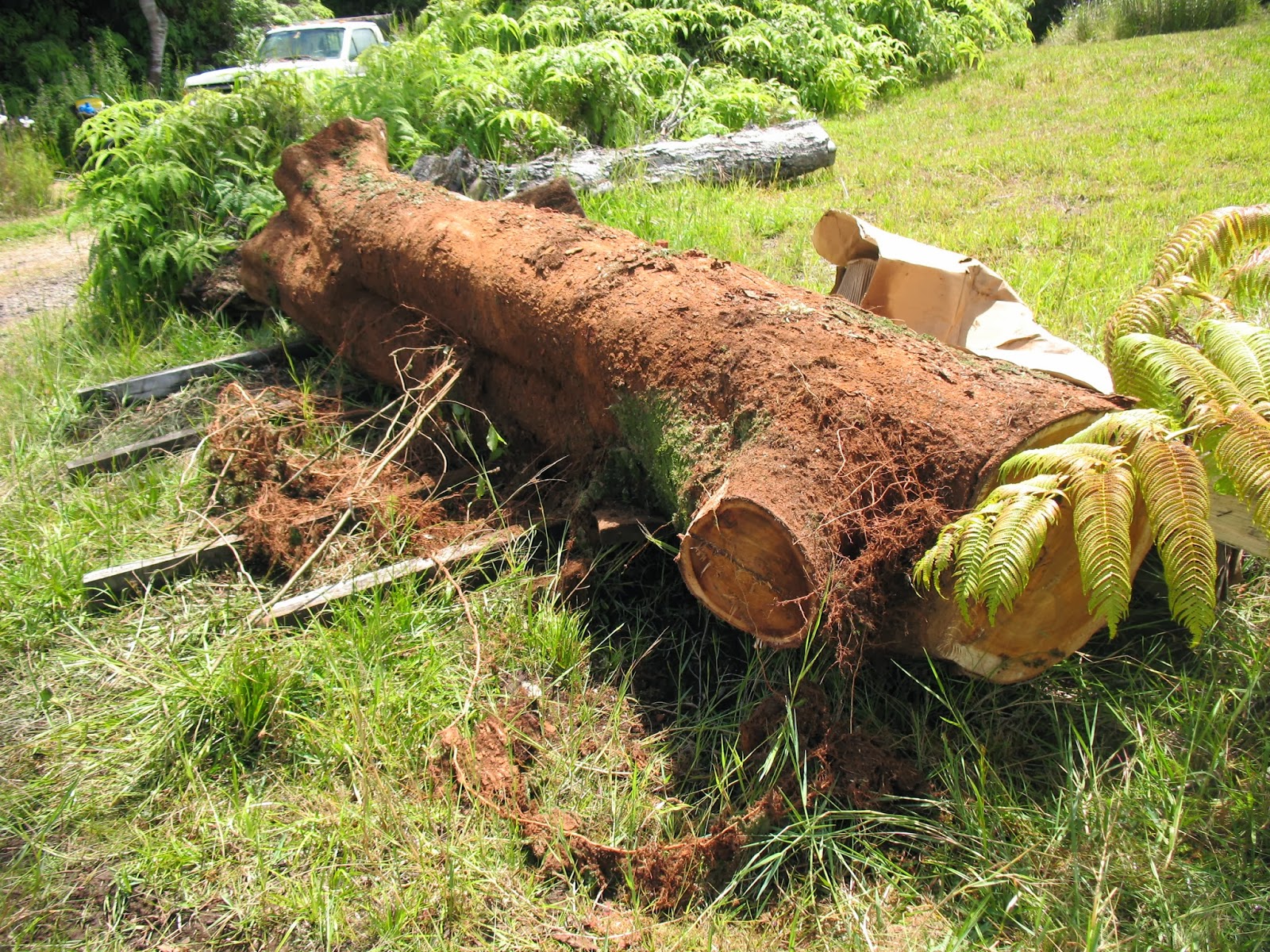
 I can not begin to express how hard you have to look for a koa log that will yield boards of this length and width. I was able to get three logs from a lot being cleared in Kaumana. One ended up being 50% rotted.
But lucked out with this one. They all were older and dying with few green leaves left on the branches.
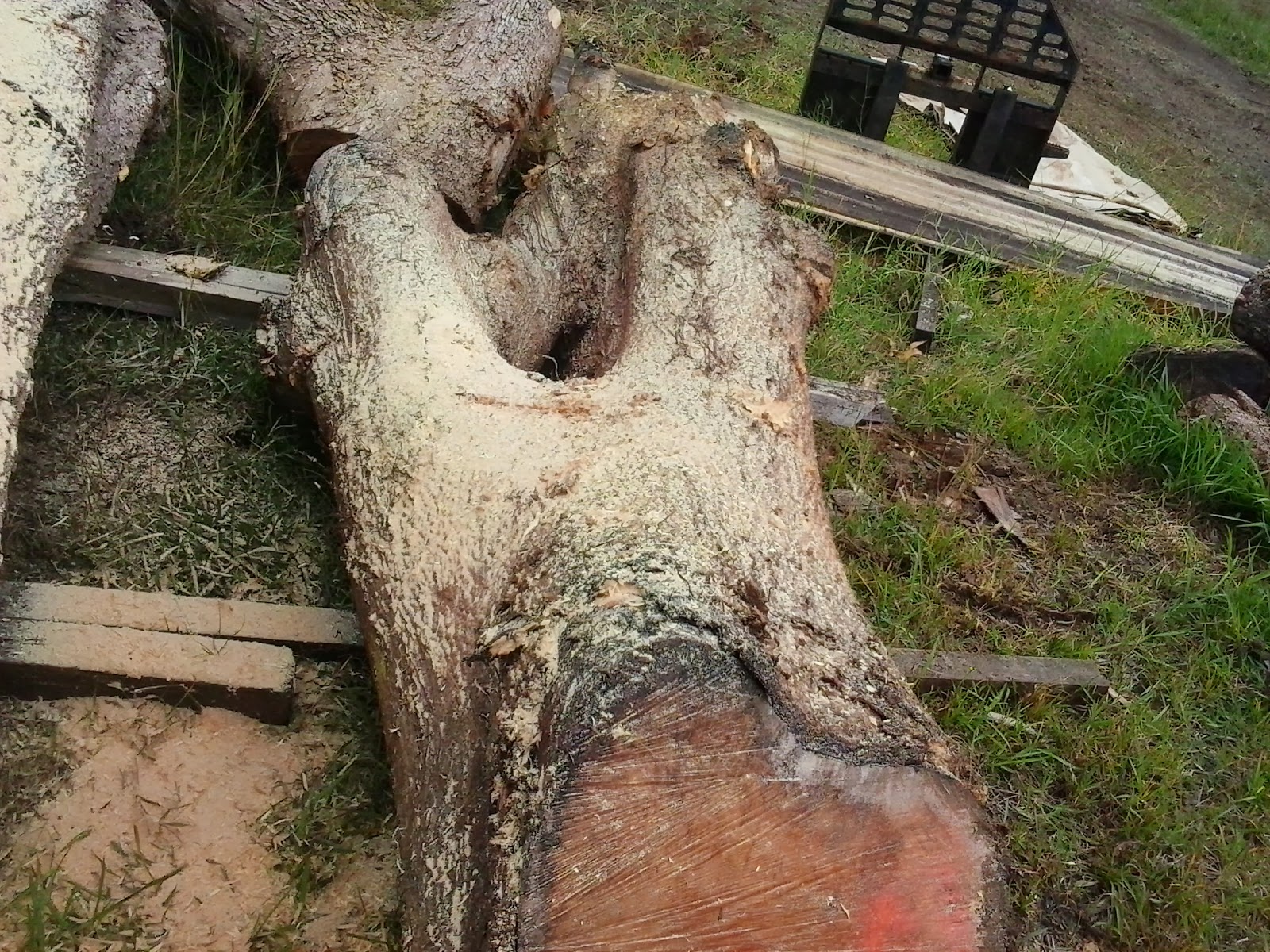
 This log had a long bark enclosure and a limb on one side. 

Most times you would cut off the crotch section but I needed  some 10' boards 18" wide.  You can never accurately tell the extent of defect caused by rot which this log had a bit coming up from the roots. Also end checking should not be under estimated so I cut thru the crotch section to get my wides leaving the boards long. This givins me more creative control down the road when it's time to cut the board to a near finished dimension  after drying avoiding whatever defects that pop up


22" wide and 14 feet long!


 I was pretty happy with myself this day.


 I was able to eek out some nice pieces with stress curl from some koa crotches and elbows as well...


Even the stump didn't go waste. I cut every small billet I could and then blocked up the rest for eventual turning material....
This is not easy work. But it's the only way you going to get it.
Lots of waste of course but plenty of good pieces for that can be incorporated in smaller tansu projects, boxes and instruments.


 Plenty of boogymen.... these are big lava stones grown up in the root mass.

My good pal Po. Faithful shop dog. Loves to help. Always hamming it up.


 This will make some nice ukuleles....


Nothing left but the bones...


It was all great fun and much sweet material come from the fruits of our labor.
We cut about 3000 board feet in 30 hours. This of course doesn't including trucking , handling and stickering. It's a labor for the love of wood.

It is all stickered and covered air drying. Hawaii being about 80~85 degrees most days and 65% humidity is perfect drying weather for wood. Combined with a constant trade wind, 4/4 koa will actually come down to about 15% moisture content in only 5~6 months here in Hilo. I then dry it further in a  300bft. solar kiln I built. It stays in the kiln until it reaches 8%. Which is a little lower than the equilibrium moisture content of wood used on the inside the house in most of the drier areas here. 8/4 still takes a good year for AD.


Thanks for stopping by and seeing what we do to bring you the very best materials for your 
uniquely handcrafted Tansu!

A hui hou........


 M A S T U K A Z E   W O O D W O R K I N G
s i m p l e  d e v i c e s  f o r   i n s p i r e d  l i v i n g 

H   I   L   O       H   A   W   A   I   I

find me on the web at

There is no tansu available other than what is currently under construction.
Pictures of current work and release dates available upon request.
Please contact me for information on available work coming out soon.
Correy@matsukazewoodworking.com