Pages

Showing posts with label Koa. Show all posts

Thursday, May 7, 2015


Last of the Curly Koa Puka Wood


Been some time since the last post.....
   It's been a great year and much has been happening  in and around the shop.
 The shop moved about a year back or so to a larger space near the Port of Hilo.
 I will post some images in the near future of the shop......

In the meantime I thought I might show you some images of this years past work
 by starting with the most recent and working back in future posts.

 The new piece features the last of the curly koa puka wood. I found one amazing plank of beautiful curl that had tons of character and used it for three chests.  It's one of those boards that make you wonder what ever happened to the rest of the tree


 So it's sad to see it go I suppose. Maybe I'll find more of it some day.....
 it is a small island after all.

The new tansu is an isho yaro similar to the other two in the series with the curly koa puka wood.

The Isho Yaro are a single piece clothing tansu. There were many differing drawer configurations some implementing safe doors and drop fit doors such as this one.
 The small drawers also allow for  areas to hide secret compartments and boxes known as hesokuribako. Which loosely means belly button chestnut box .....

                                This piece is made with the last of the curly koa puka wood.
                                                             It  measures 18.5x36x42. 


 Here it is at The Harbor Gallery in Kawaihea Harbor, Hawaii.
 The tansu is currently showing and exclusively available at the Harbor Gallery.


 As with the others, the top and sides were made from single wide koa boards. These are amazing   
(and hard to find). I was able to use book matched sides. Both with the same mineral patterning . Just beautiful. 


 The top has a few bark enclosures that compliment the drawer fronts.


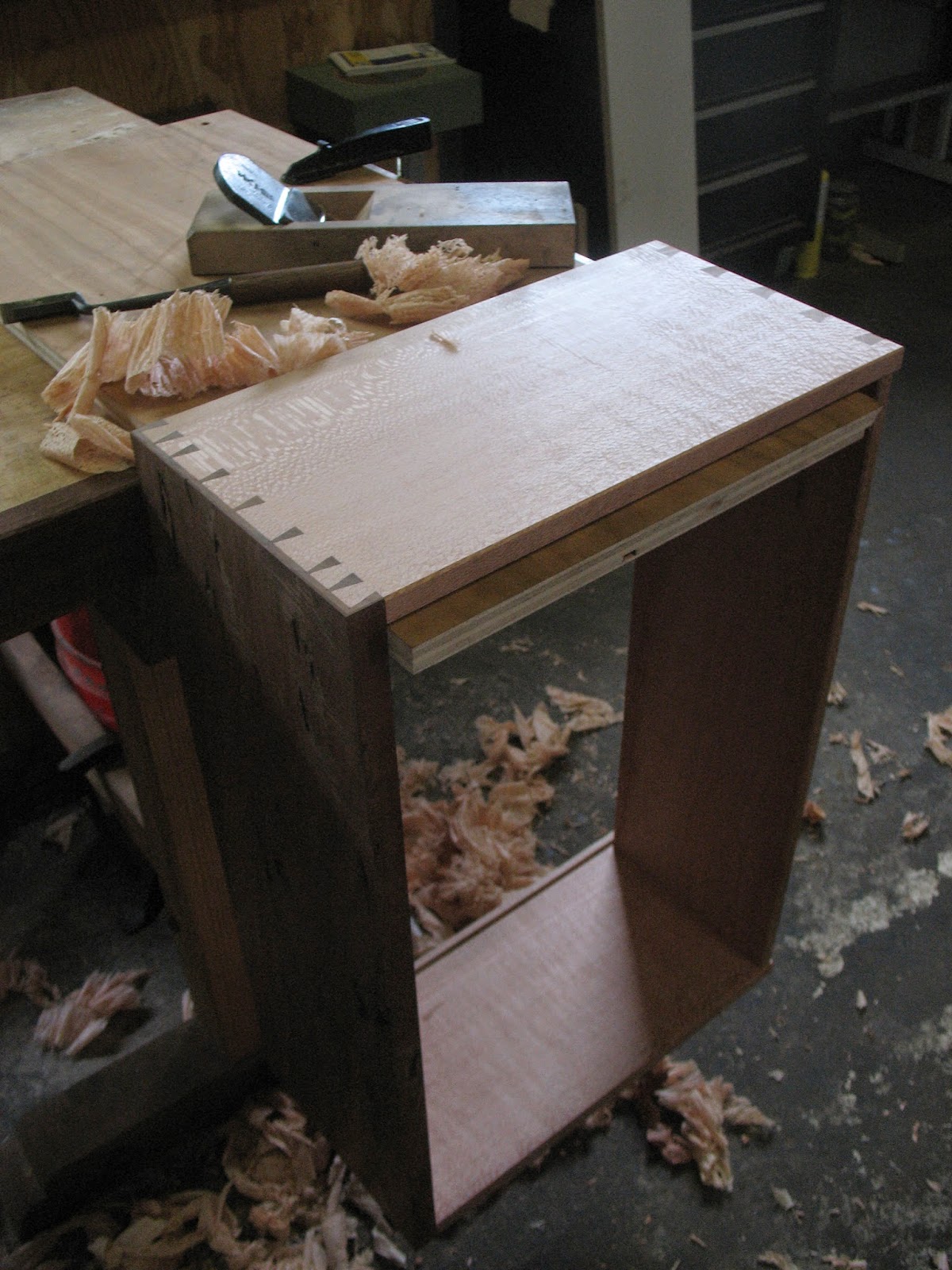
 The whole work is fully joined with dovetailed carcass and drawers. 
All the major partitions are joined to the carcass with 6 pairs of tenons and two sword tip tenons, backed with yet more tenons lol.
Hard to believe there are more than 90 mortice and tenon joints in the piece.


 The cut-outs in the tansu sides draw inspiration from the mokko pattern.


 Drawers were made with figured Silky Oak and Port Orford Cedar drawer bottoms


 The drawer fronts were veneered with a shop sawn veneer. 
The veneers are thick enough to finish plane the faces like solid wood.


To make the design unique from the previous versions,  I added a kendon buta  ( drop fit door) . 


  Here is a pic of the door fitted and the bead detail carved in.
.

Inside is a pair of small drawers made from a very tasty Stress Curl Koa. It actually came from the same tree as the sides of the tansu.


 Then behind drawer number two we find a hidden box made from Milo 


Then there is one more hidden box behind a larger drawer.
 The boxes are designed to fit dollar bills.
 This one here is made from Kamani.


 The handles are custom cast

 The castings get cleaned up and edges filed smooth.


Here are the backplates in the different stages oif fabrication
From back to front, we have the laser cut blank, then after it was hammer finished,next is with the edges all hand filed to a neat bevel and finally oil blackened.


 Here is the whole suite prior to installing...


The finish I have been using most exclusively for some time is a french polish.
 I use a high grade German refined dewaxed shellacs.  The finish has high clarity with a deep luster and adds a bit of warmth like an analog recording. The finish is then finally rubbed with a homemade bee's wax polish. It's quite water resistant, no white rings. And it patinas nicely.


 Thank-you for stopping by and seeing the new work. Please do not hesitate to contact Gunner or Elli to check it's availability. 

 In the next post I will share some images of a kodansu my smallest tansu yet.

 A few last construction pics on the way out........


If you are interested in this current work , it is currently showing and exclusively available at 
The Harbor Gallery in Kawaihea Harbor, Hawaii .
 You Can reach Gunner and Elli Mench at 808.882.1510 
 They are great people hosting a very nice gallery featuring over
 150 Hawaii Island Artists next to Cafe Pesto.


 This is the only work currently available from Matsu Kaze Woodworking.
 Work is always on going and in process. 
Please feel free to contact me if interested in work currently in production or coming soon.


matsukaze woodworking
simple devices for inspired living


Sunday, March 2, 2014

Matsu Kaze Woodworking

Wins First Place In Joinery Category
at Harbor Gallery's Annual Wood Show

Thank you to everyone who attended the show and voted my piece to First Place in the Joinery Division.
It was a great showing of some of the Island of Hawaii's best woodworkers and artists.
A catalog of the show is found on the Harbor Gallery web site
Here is some of the local coverage of the Event in the local papers 
West Hawaii Today 2-28-14

A previous post on the piece when it was first completed can be read here


 This Piece is Exclusively Available through the Harbor Gallery
808-882-1510
Contact them Now to own this Award Winning Tansu

Mahalo nui loa,ありがとう、and many thanks to everyone.

 SOLD  MARCH 2nd Thank-you.

M a t s u  K a z e  W o o d w o r k i n g
simple devices for inspired living

info@matsukazewoodworking.com


Friday, December 13, 2013

December Current Events

 Thank-you  and mahalo for visiting the 
Matsu Kaze Woodworking
BlogSpot

MANGO

 Mango is a very sweet wood common here in Hawaii. It makes beautiful furniture and architectural woodwork.  It's not so much planted for it's wood as it's fruit and is usually harvested from
residential areas. I have done a few pieces with it and enjoyed it's workability and beautiful figure.

mango chadansu 2011 12x26x30

Over the past few weeks we have been quite busy getting wood put away for next years and there after's work. I had picked up a nice deck of mango logs from a local tree cutter, finally made some time to get them milled. We make tansu, moldings, and architectural woodwork with mango. It's popularity here is only second to Koa, and probably only beats out Milo because of it's availability .

2011 mango isho kasane dansu 18x38x40


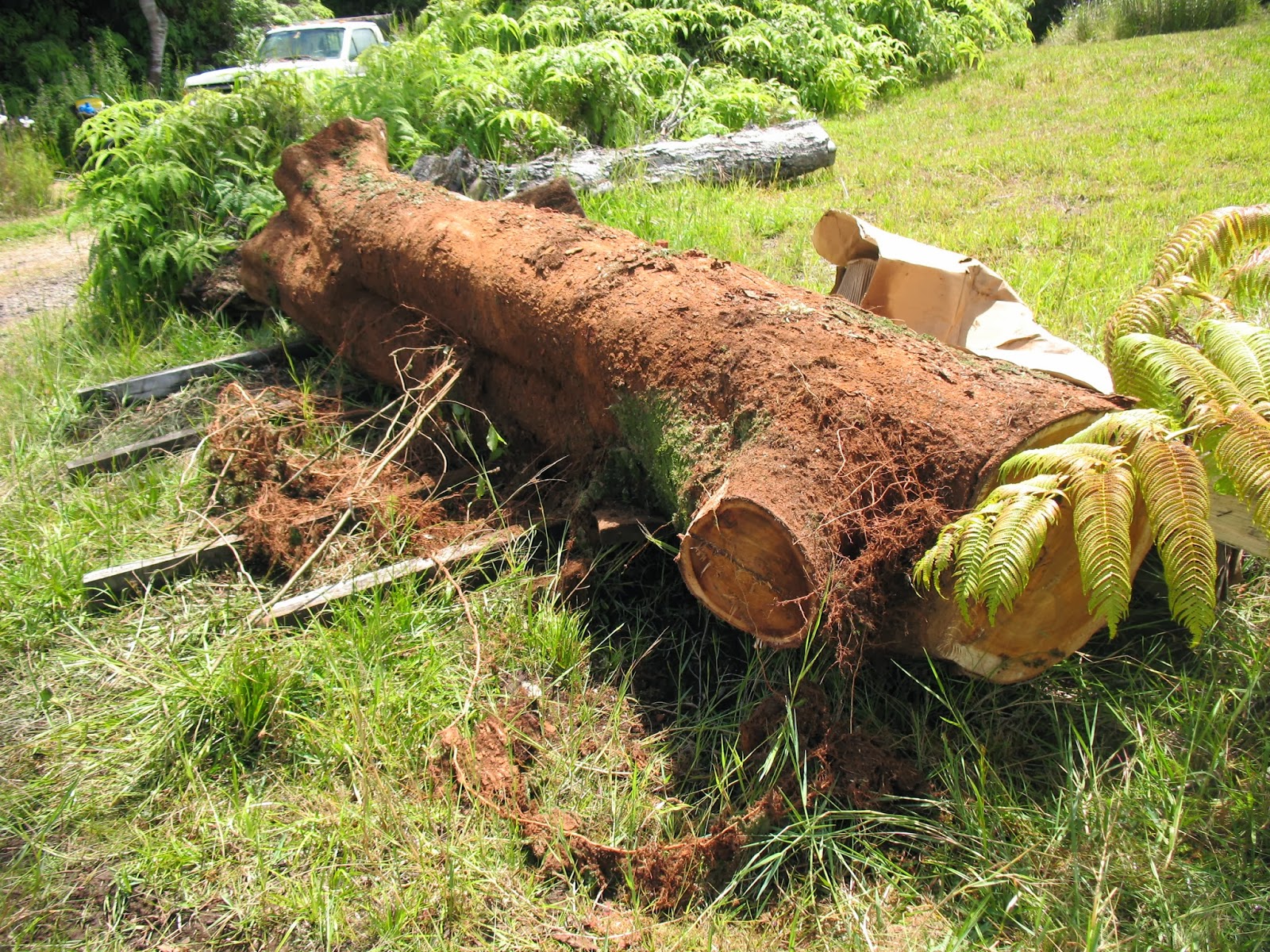
Picking up these mango logs was nice and easy this time around as I only had to back my trailer up to get them hoisted by crane on to it. Sure beats breaking them down in to cants
on rough terrain and dragging out or the bushes by hand! So I was very please with the ease and expedience of it all.

 The poor trailer. It's actually rated for 3500lbs. I guess I test the limits of most things.
I see a larger  truck and trailer in the not so distant future......
But I am exceptionally happy with the work I get from my Taco and trailer.
This log is about 11 feet long and is all of 3500lbs if not more .


 Here are some more pics of the mango logs.... 
 and yeah that's me, sorry I can not take a serious picture, never have. But it gives scale to the size of the logs. The average is about 24~30 butte diameter.


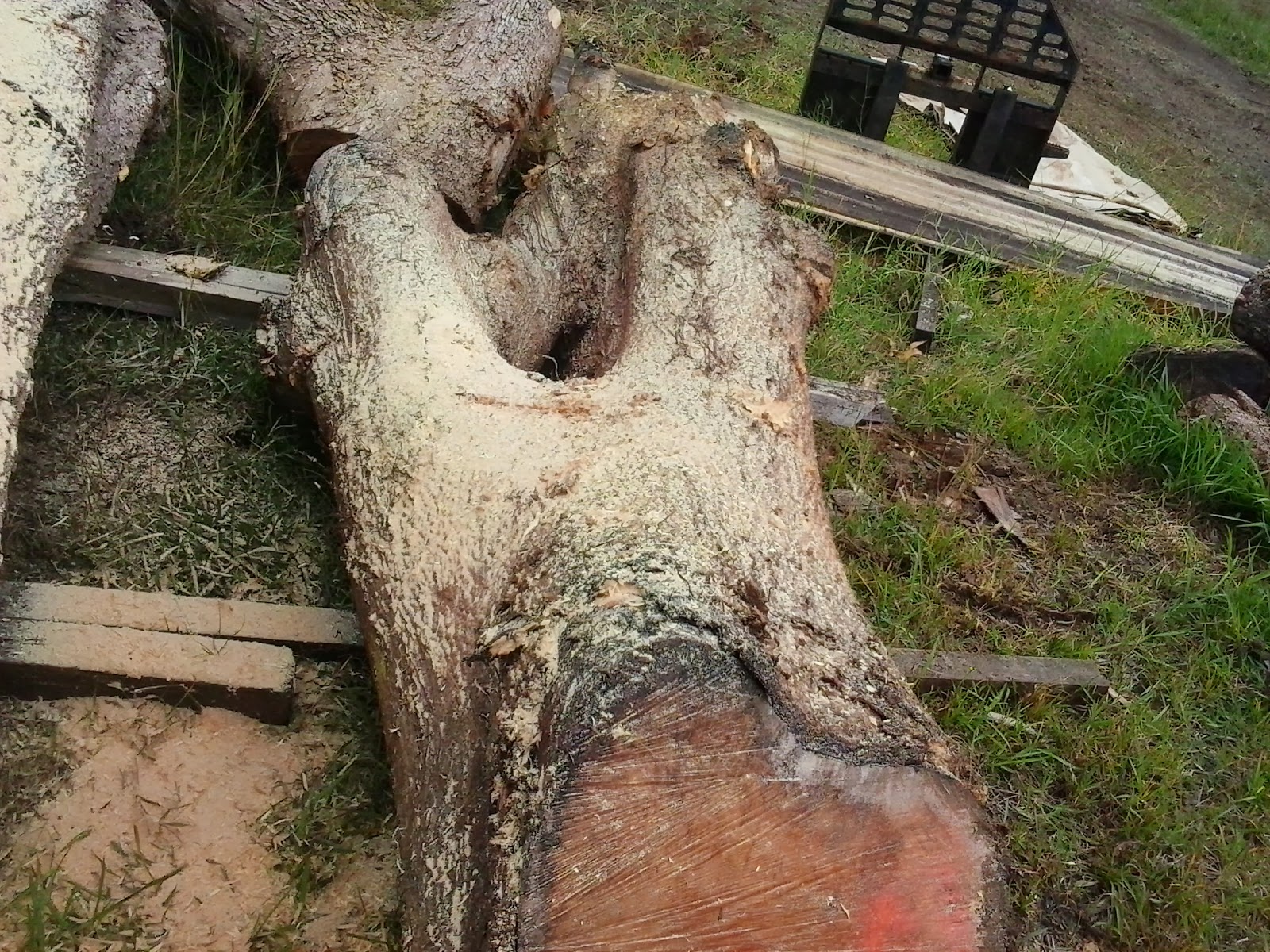
As you can see they can be quite fluted and winding.  The log to the center right  is a big Y shape or "crotch" setcion. The log is way too big for the mill and so I needed to first cut it into two halves with a chainsaw.


 Then off to the woodmiser....

\
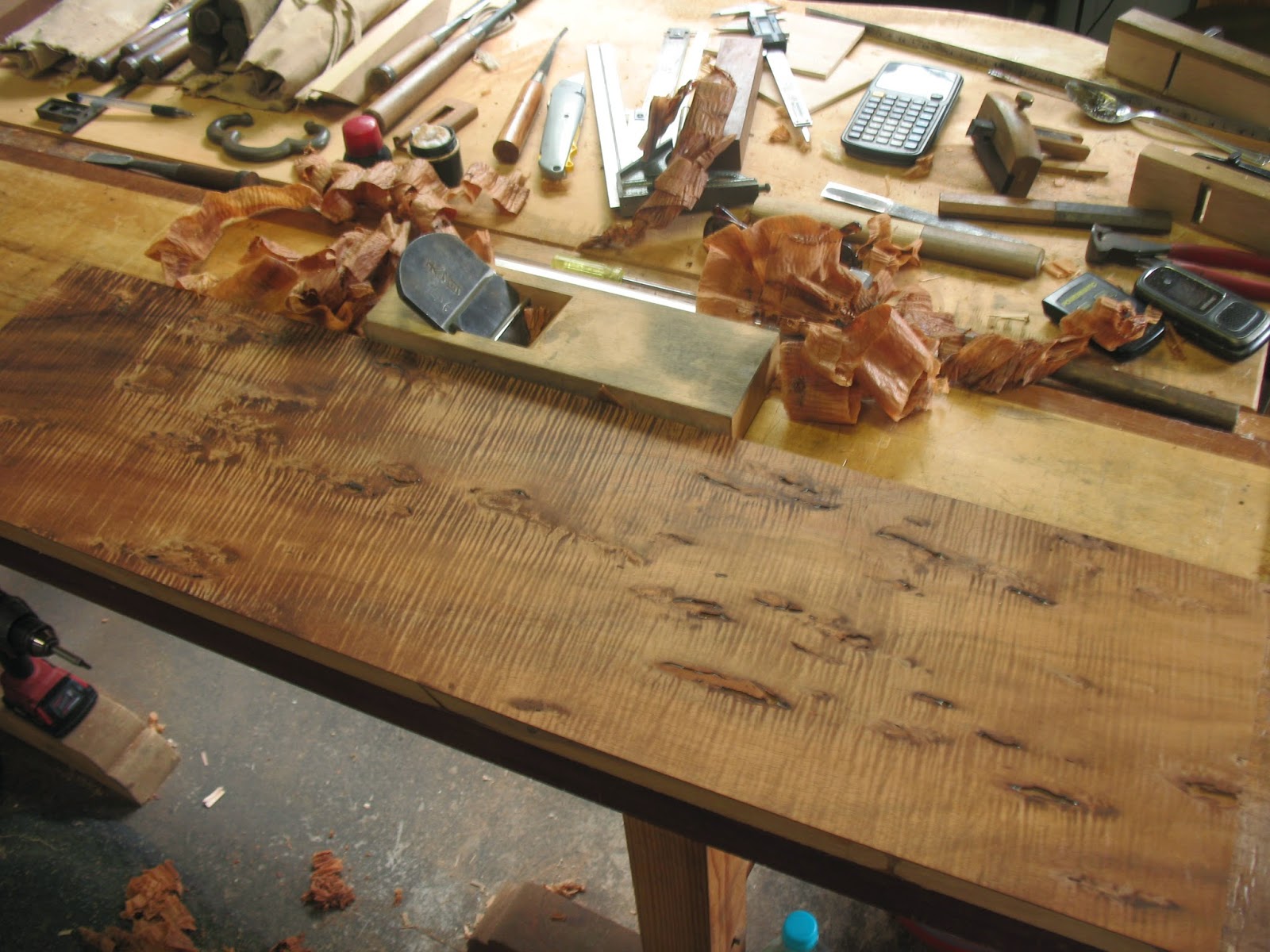
This lot of mango has some curl figure which is what we are after here. But it will be most prevalent on a quatersawn face.

 pictured above is quarter sawn mango with a garnet shellac finish.

But with logs that are oddly shaped and twisted it's exceptionally hard to follow the quarter. The pith meanders, and there is much waste and many short pieces accumulate. 

Now the log is edged and squared below, ready to start taking off some boards.


The outside of the cants and logs yield some funny abstract shapes, like fish!
 After the  wane is cut away you can start to see some really nice material emerge.
Above we have beautiful high figure mango that will make beautiful drawer fronts and door panels.

Below is a flitch of some 20" wide boards that will be some tasty single piece tansu sides and tops.


 Here is another hard cut log. 
It needs to be cut into three smaller logs sections for the mill.
Interesting how it grew back into itself.

You would think this will be great figured areas but they are very low yield. You only net about 50% at best. There is run out grain in every direction making very pretty but unstable wood prone to all kine warp. It will all be shorter lengths. Short pieces will make great cabinet parts and instrument material for ukulele and guitars.

 And yet another funky log.
These logs tend to be very time consuming to get  select dimensional lumber from. I will get a couple wides in the middle then the rest will be narrows and shorts.

This proceeded along in the same manner till we got to the bottom of the pile.
 All the mango was milled with projects in mind, 4/4 for moldings and drawer faces, 5/4 for extra wides in the 20" range as they will probably cup an entire 1/4" so you need to plan ahead for that. I also cut plenty of 10/4 for table legs and such, it also will allow me to resaw it again if need be for thinner parts like door panels. I try to keep my options open as much of this I will not use for a couple years from now.

Why do I do this?????? 
     It's a heck of a lot of work until after dark most days. Each day you need to stop early enough to spray your fresh cut lumber for bugs and get it stickered. The powder post beetles come out most every night about an hour before dark and if the fresh cut lumber and log ends are not treated with an insecticide they will be inundated with the PPB. 

       I do all this because you can not find a boards much over 12 to 14 " wide at most any mills.  I get guys telling me that "wide boards are too heavy to carry and who wants something that wide anyway".... I DO!!
       Much of the colonial furniture made in the US started out using a single plank for the tops and sides of the chests and dressers. Two board table tops were not uncommon.  Quality antique tansu used single piece tops and sides.  In both countries as the old growth forests were depleted there were two board sides and single piece tops. Then three pieces sides and two piece tops. Now you even see table tops with many narrow boards glued together to make up the width. It  never appealed to me. 
To me part of the charm of older work was the use of wide boards. It's just hard to compete with nature.
It's one of the aspects of a bygone era that I enjoy incorporating in my tansu.
  A few parting images....

Some tamarind we cut  ....
starting to spalt, now growing mushrooms...


podocarpus,  a Japanese Yew.....


Persian walnut?? very very hard. Smaller diameter log, maybe 16".

heart wood was very small but I liked the scattered dots on the sap wood.


 There was also some really nice crotch sections of mango...
20" wide!! We ended up with several boards in this flitch.

I am so excited to use some of this. 

We also cut some 800 feet of port orford cedar from cants we brought in from East Fork Lumber Co. in Oregon. We have available 18" wide quartersawn old growth  POC. And PLENTY of 12~16" QS in length up to 10'. I also cut some 6x6 that would make nice shoin style tokobashira,  gate posts, etc.. Plenty of shoji material, but I use much of it for drawer boxes and cabinet backs in my tansu work. 

The plank below is 18" wide and 30~50 rings per inch.  Truly a rare specimen. These will be resawn for panels to make matching two piece hip boards for shoji  and itado after they dry. I have another 250bft of tight grain old growth dimensional dry and ready for projects.


 Oh yeah, almost forgot the Koa. Jeez, that's what we were here doing to begin with!
O.k. Just a few pics to wrap up..... didn't I say that 15 pics ago??LOL

 I can not begin to express how hard you have to look for a koa log that will yield boards of this length and width. I was able to get three logs from a lot being cleared in Kaumana. One ended up being 50% rotted.
But lucked out with this one. They all were older and dying with few green leaves left on the branches.
 This log had a long bark enclosure and a limb on one side. 

Most times you would cut off the crotch section but I needed  some 10' boards 18" wide.  You can never accurately tell the extent of defect caused by rot which this log had a bit coming up from the roots. Also end checking should not be under estimated so I cut thru the crotch section to get my wides leaving the boards long. This givins me more creative control down the road when it's time to cut the board to a near finished dimension  after drying avoiding whatever defects that pop up


22" wide and 14 feet long!


 I was pretty happy with myself this day.


 I was able to eek out some nice pieces with stress curl from some koa crotches and elbows as well...


Even the stump didn't go waste. I cut every small billet I could and then blocked up the rest for eventual turning material....
This is not easy work. But it's the only way you going to get it.
Lots of waste of course but plenty of good pieces for that can be incorporated in smaller tansu projects, boxes and instruments.


 Plenty of boogymen.... these are big lava stones grown up in the root mass.

My good pal Po. Faithful shop dog. Loves to help. Always hamming it up.


 This will make some nice ukuleles....


Nothing left but the bones...


It was all great fun and much sweet material come from the fruits of our labor.
We cut about 3000 board feet in 30 hours. This of course doesn't including trucking , handling and stickering. It's a labor for the love of wood.

It is all stickered and covered air drying. Hawaii being about 80~85 degrees most days and 65% humidity is perfect drying weather for wood. Combined with a constant trade wind, 4/4 koa will actually come down to about 15% moisture content in only 5~6 months here in Hilo. I then dry it further in a  300bft. solar kiln I built. It stays in the kiln until it reaches 8%. Which is a little lower than the equilibrium moisture content of wood used on the inside the house in most of the drier areas here. 8/4 still takes a good year for AD.


Thanks for stopping by and seeing what we do to bring you the very best materials for your 
uniquely handcrafted Tansu!

A hui hou........


 M A S T U K A Z E   W O O D W O R K I N G
s i m p l e  d e v i c e s  f o r   i n s p i r e d  l i v i n g 

H   I   L   O       H   A   W   A   I   I

find me on the web at

There is no tansu available other than what is currently under construction.
Pictures of current work and release dates available upon request.
Please contact me for information on available work coming out soon.
Correy@matsukazewoodworking.com